



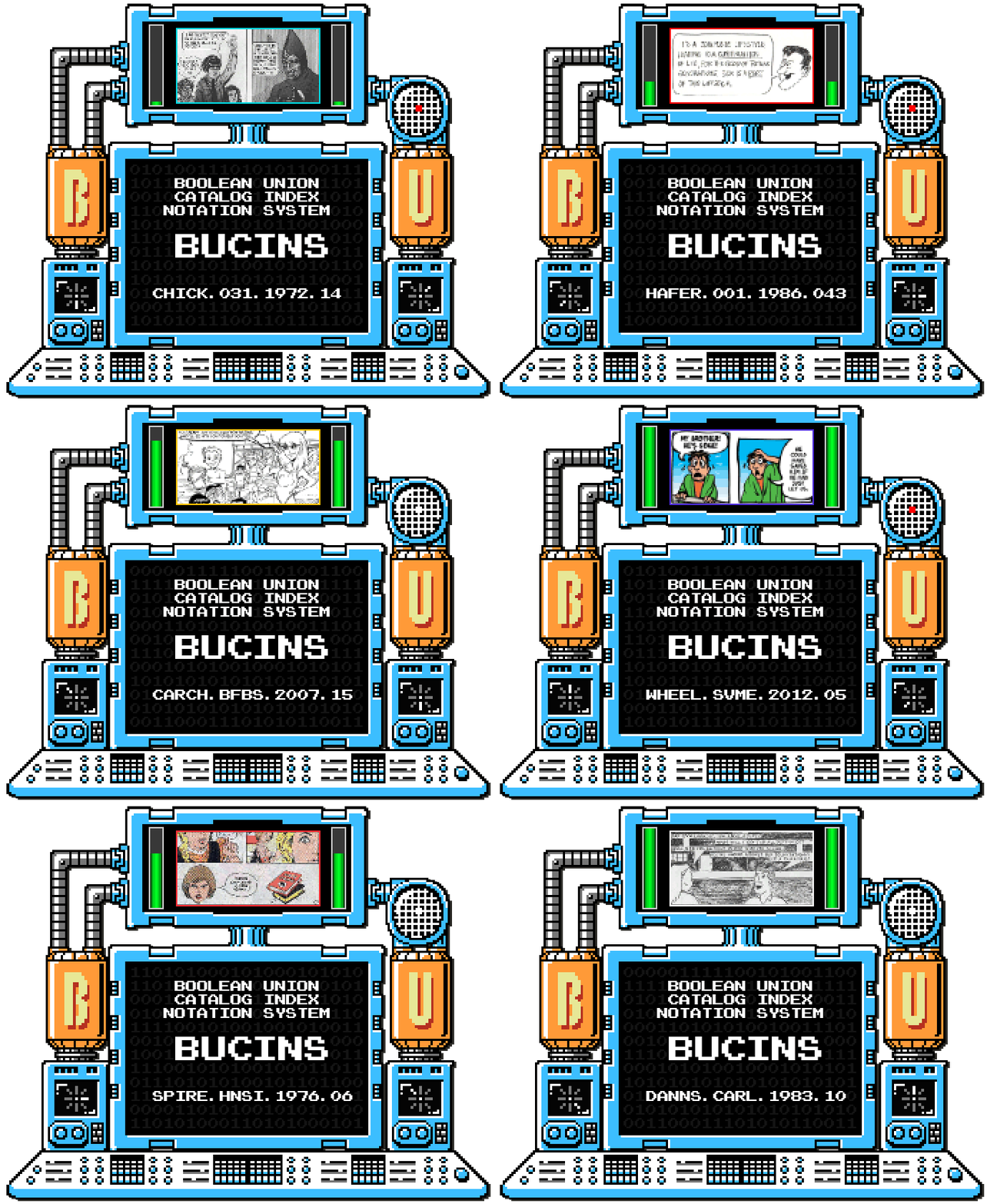
 Introduction ⇑ ⇓
There are a wide variety of catalog schema employed by academics, researchers, collectors and various other individuals to archive and discuss a particular corpus of published works. One of the most widely known in the United States is the Dewey Decimal System, utilized by numerous libraries therein and which forms the basis of the Universal Decimal Classification System used for much the same purpose elsewhere in the world. When it comes to comic books, the fan communities of different publishers and series frequently develop specialized systems individualized to those particular works, and those works covered by this website are certainly no exception.
While numerous attempts have been made to develop a unified system to catalog those works released by Chick Publications over the years, including those proposed by Fowler, Kursteiner and others; no single system has been able to account for all the numerous peculiarities present in Chick's history of publication, nor has yet to achieve a plurality of acceptance over another. As the works of other writers in addition to Jack Chick are also covered by this website, we have likewise attempted to develop such an indexing system to better organize those books and comics relevant to our research.
Referred to as a BUCINS (boō sinz) code, the notation system employed by the Boolean Union seeks to incorporate the most relevant portions of these preceding systems in a practical, unifying manner. The general syntax of a BUCINS code is as follows:
[Publisher].[Title].[Year].([Language]).[Page/Panel]
e.g. CHICK.001.1970.EN.03A
Publisher ⇑ ⇓
The first portion of the code consists of a five letter indicator to distinguish the publishers of the specific work being referenced. The current list of these as used by the Boolean Union are shown in Table 1:
Table 1: Publisher Codes| BUCINS Designation | Publisher |
|---|---|
| CHICK | Chick Publications |
| DANNS | “Chaplain” Dann Slator |
| TTODD | Tim Todd (Revival Fires Ministries) |
| SPIRE | Spire Christian Comics (Al Hartley) |
| WHEEL | Ron Wheeler |
| CARCH | Catholic Archdiocese of New York |
| HAFER | Dick Hafer |
| LIFEM | Life Messengers |
| GDSND | Godsend - Spiritual Warrior |
| LOKMN | Vic Lockman |
| CPOBB | Christian Publicity Organisation |
| BRAVE | Brave Books |
| OTHER | Other Works |
| KNGST | Kingstone Comics |
Title ⇑ ⇓
The next section of the code references the specific published piece. This would be the individual tract, book, comic, pamphlet, etc. being discussed. When referencing the tracts or comic books issued by Chick Publications, either the four letter designation established by Robert Fowler[A] (Fowler Code) or the three digit number used by the Jack Chick Museum of Fine Art may be used. For example, the following codes would all be considered valid and would each refer to the leftmost panel on the third page of the 1970 edition of the first tract published by Jack Chick, Why No Revival? ("Christians of Yesterday!" panel):
CHICK.001.1970.03A
CHICK.WHYN.1970.03A
As Fowler's seminal work was published in 2001, prior to the release of a number of later Chick tracts and comics, we have endeavored to create comparable codes for these later works ourselves using a similar methodology. Additionally, there were several tracts which were “officially” re-released with significantly modified art or under new titles, but which maintained most or all of the same plot points and/or text. These new editions were issued completely different Fowler Codes to reflect their new titles, but when addressed by their release numbers, those numbers are appended with a letter. The Chick tract This Was Your Life! was originally drawn by Jack Chick himself and featured a man who dies and is shown a recounting of the events of his entire life while undergoing divine judgment. This same tract was later redrawn by Fred Carter to feature an African man instead (It’s Your Life!) as part of their Black Tract Series, then again by Chick to feature a Caucasian woman (You Have a Date!), then again by Carter to star an African woman (Your Big Moment), and finally again by Chick with a Middle-Eastern/Muslim gentleman (Your Best Life). Each of these versions has a distinct Fowler/Boolean Union code, but as they are essentially “re-skins” of an already released tract, the “tract number” assigned to each would still be that of the original tract (003) with a letter included to denote release order. The table below (Table 2) shows the BUCINS Codes for the above example...
Table 2: BUCINS Codes for Tract #003 and associated rereleases| Title | Tract # | Fowler / BU Code | Publication Year | BUCINS Code |
|---|---|---|---|---|
| This Was Your Life! | 003A | TWYL | 1964 | CHICK.003A.1964 or CHICK.TWYL.1964 |
| It's Your Life! | 003B | ITYL | 2006 | CHICK.003B.2006 or CHICK.ITYL.2006 |
| You Have a Date! | 003C | YHAD | 2011 | CHICK.003C.2011 or CHICK.YHAD.2011 |
| Your Big Moment | 003D | YBGM | 2011 | CHICK.003D.2011 or CHICK.YBGM.2011 |
| Your Best Life | 003E | YBTL | 2014 | CHICK.003E.2014 or CHICK.YBTL.2014 |
Year ⇑ ⇓
Endemic to Chick’s work is the re-release of previous publications, sometimes with minor (and occasionally major) modifications to the art, content or even title. The inclusion of the copyright/publication year in the code is to differentiate earlier editions of a particular title from later releases or revisions. A number of Chick’s publications also had re-releases which changed the contents of the title without a subsequent update to the publication year listed. In circumstances such as these, we append the year with a letter to categorize these pieces in approximate release order as can best be determined. For example, the 1992 edition of the tract The Last Generation was modified to correct minor spelling mistakes and to make slight alterations to alleviate continuity errors from previous releases. However, both of these versions bear the copyright date “1992”. We have classified these as CHICK.031.1992A and CHICK.031.1992B respectively.
Language (Optional) ⇑ ⇓
Most of the works handled by Boolean Union were originally published in English. However, some works saw translations into other languages to boost their accessibility and reach. This is especially true of a number of Chick’s tracts, of which a particularly egregious example is (again) This Was Your Life! Over the years, this tract has seen translations into over 100 different languages including Spanish, German, Fijian, Blue Hmong, Hiligaynon, Waray-Waray and numerous others. Some of these translations (such as the aforementioned Waray-Waray and Fijian versions) involved numerous changes, (both subtle and overt) to the art as well as the text.
While the language portion of the BUCINS is optional, it should be included when referring to a version of a work in any language other than English. If the language portion is omitted from the code, it can be assumed to be referring to the original (English) edition of the work. Languages are indicated using either the two or three letter codes established in the ISO 639-1 Code standards. Thus, the full BUCINS codes for the language variants mentioned above would be as follows…
Table 3: Language Codes for variants for Tract #003 and associated rereleases| Language | BUCINS Code |
|---|---|
| Spanish | CHICK.003A.2001.ES |
| German | CHICK.003A.2002.DE |
| Fijian | CHICK.003A.2000.FJ |
| Blue Hmong | CHICK.003A.1996.HNJ |
| Hiligaynon | CHICK.003A.2022.HIL |
| Waray-Waray | CHICK.003A.2001.WAR |
Page / Panel ⇑ ⇓
Utilizing a consistent methodology is vital should one wish to discuss or compare specific images or portions of text between different works (or between different editions of the same work). An idiosyncrasy unique to Chick tracts is that, unlike standard comic books, the outside of the front cover is considered to be “Page 1” with the inside of the front cover being “Page 2” and so on through the outside of the back cover typically being labeled “Page 24” owing to the standard chick tract containing 18 internal “pages” plus both sides of the cover. To maintain standardization, this is a practice we have also adopted when discussing publications by other authors, including full-sized, more “traditional” comic books.
Comic pages are most typically segmented into individual images, or “panels” and when referencing a specific image, all panels are denoted with a letter added to the page number and progressing from left to right, and top to bottom on the page. See the following illustrations…


The only exception to this would be variations of works published in languages which do not follow the typical western convention and instead are read from right to left such as Japanese, Hebrew, etc. When denoting individual panels in these editions, the panel lettering is mirrored accordingly. For example…

Deciphering Chick Print Codes ⇑ ⇓
Anyone who has handled a modern, physical Chick tract has no doubt taken notice of the odd series of letters/numbers which appears on the back cover. Chick Publications utilizes a rather esoteric system of its own to organize and catalog, and identify its vast library of tracts and this system has seen several major overhauls over the many decades Chick Publications has been producing tracts. Every tract is assigned a unique "catalog number' which is unchanging and is used to identify the tract within Chick's internal system. This is sometimes referred to as a "stock number" and is utilized by the Chick.com website to reference a specific tract from their internal database. Examples of these types of catalog numbers are "0003" for the title "Somebody Goofed", "0084" for the title "The Gay Blade", "0512" for "The Nervous Witch", and so forth. While catalog numbers for a particular title do not change, catalog numbers between different language versions of the title do. For example, the original English version of "This Was Your Life" is catalog number "0001" while the Spanish language version of the same tract is "0520" and the Italian language version is "0718". With the exception of tract which utilize Version "0" codes (below), a tract's catalog number is generally also found on the back cover either integrated into the print code as a whole, or separately in the center of the cover along the spine. Humerously (and not at all surprising) the catalog number "0666" has never been assigned to a particular tract[A], and this maliferous code maps instead to a "Bulk Returned English Language Tracts" item in Chick's database.
Depending on the age of the tract in question, the particular print code can be formatted in one of several different ways. These include...
Back Cover of Tract #014 "Bewitched", printed in 1970 and containing no specific print code.

 Back Cover of Tract #014 "Bewitched", printed in 1970 and containing no specific print code.
Prior to 1972, tracts bore no identifying codes whatsoever. This was likely due to a combination of the relatively small size of Chick's catalog to to this point as well as a lack of information as to how large or how swiftly the overall size of their library would grow over the next few decades. If a particular tract you hold in your possession does not contain a print code then, depending on the particular title and its overall condition, you may have access to a rather valuable piece of Chick history. As previously mentioned above, these tracts also do not display their catalog numbers, which subsequently must be deduced either from the Chick website or from later printings / variants of the same title. While some tracts which were printed after 1972 also occasionally lack print codes as well, this is by no means a hard and fast rule.
 Back Cover of Tract #002 "A Demon's Nightmare", 1972
The first actual attempt at establishing an organized identification system for tracts came into use somewhere around 1972. These Version 1 print codes would generally consist of the following format...
[Catalog #]/[Alpha Code]-[Language Code]-[Unknown]-[Run]
e.g. 04/D-E-U-I
As in the provided example, this print code consists of the tract's catalog number (04), an "alpha code" which typically consisted of the first letter of the tract's title ("D" for "A Demon's Nightmare"), the tract's language code ("E" for "English"), and unknown identifier which is always "U" for all tracts which utilize this schema and have been located thus far, and a letter indicating the tract's run ("I" for the 9th printing of this particular title). While "alpha codes" typically involve the first letter of a tract's title, a specific tract can reference more than one "alpha code". For example, see this version of the tract "Why No Revival" which instead utilizes the code "W3" and which might suggest an additional variant which might have fallen between the original 1961 Rusthoi "large print" version and the later, yellow cover "Ichabod" variant. This system was in use from approximately 1972 through somewhere around 1979 when both the "alpha code" and "language code" portions were discarded. Following this, print code from 1979 until Version 2 went into effect instead utilized the following format...
 Back Cover of Tract #006 "Somebody Goofed", 1972
[Catalog #]/[Run]
e.g. 03/X
Like before, this example contains the catalog number (03) and the tract's run sequence ("X" for the 24th printing). As can be inferred, earlier letters represent an earlier printing and, therefore, a potentially more valuable tract.
One additional point of note is that due to modifications to the California telephone network, the area code for Chick Publication's office line was changed on November 14, 1992. If the telephone number which appears on the back cover of a specific tract is listed with a (714) area code then it was likely printed prior to November of 1992. If the area code is instead listed as (909), then it can accurately be dated to 1993 or later.
As Chick's catalog increased exponentially in size as the new millenium approached, his need for a more flexible and dynamic system quickly became a necessity. Beginning around 1994 a switch was made to a new system which focused on the date of a particular printing rather than on an arbitrary sequence. All of the codes utilized in this new system attempt to capture the year, the month, and sometimes even the day on which a specific tract rolled off of Chick's presses. These codes took a few different forms over the years which included...
[Month].[Year] or [Month][Day].[Year]
e.g. 10.5 or 1217.8
 Back Cover of Tract #283 "But Everyone Does It", 2023
In these examples (for later printings of "Holy Joe" and "Hard Times" respectively), the month is represented by a two-digit number ("10" for October, "12" for December, etc.) and a one-digit number to represent the year from 2000 to 2009 ("5" for 2005, "8" for 2008, etc.). Even later on, this system was further modified to include both the day on which a particular printing was struck as well as expanding the year to two (and later to four) digits to account for dates which fell after 2009. These take the format...
[??].[Month][Day][Year].[??]
e.g. 5.08092023.03
Here we see a printing of "But Everyone Does It" which was run on August 9, 2023 (08-09-2023). Print codes which appear in this format are both preceeded and followed by additional numbers, seperated by periods, whose significance is currently unknown.
Fowler's Long Form ⇑ ⇓
In our efforts to devise a cataloging system, we referred to the work of Fowler’s in his book regarding the collection of Chick Tracts[A]. Yet, upon several readings, it became apparent that his system was quite complex for what it aimed to accomplish relative to ease of comprehension. This would be especially true when you consider cases of the person who may not hold much (if any) interest in the collection of Chick Tracts, but still wanted to have a rough idea of how to gauge the rarity of an individual tract to better influence their decisions on how to handle it. To explain exactly how complex of a system Fowler was operating from, we will go through the fifth chapter of his book and condense it.
According to Fowler, there are up to nine pieces of information that can be directly derived from the tract itself as presented by Chick and which should be included as ingredients to any sufficiently thorough catalog system. These are:
- Title
- Colour
- Copyright Year
- Language (can be present on the tract itself or deduced)
- Catalog Number (from 1972 onward)
- Print code (from 1972-1994; replaced with a date code, first as mm.y, then mmdd.y from 2000, mmdd.yy in 2010 and eventually replaced with the new code of x.mmddyyyy.y, where x and y are currently yet unknown.)
- Alpha code (from 1972-1979)
- Language code (from 1972 - 1979 and is provided by Chick. Different to deducing the language as above, but could be merged together).
Fowler then proceeds to list another eight additional (but somewhat optional) components that he nonetheless considers to be of value. These include:
- Title code (four letters e.g. TWYL for This Was Your Life). Notably, Fowler did not write such codes for all tracts.
- Language code (3 letters e.g. ENG for English, SPA for Spanish).
- Print Series code, in cases where certain tracts have more than one print series. This often takes the form of a lowercase letter added to the four letter title code (e.g. TWYLa and TWYLb)
- A promotional type code is necessary to easily distinguish between two parallel types of the same tract which are intended for distribution through either the manufacturer (Chick Publications) or resellers (Christian bookstores). For such tracts, a type code letter of "m" and "r" is added to the title code (e.g. TWYLm and TWYLr). Tracts can have both print series and promotional type codes as well (e.g. TWYLam and TWYLar).
- A “race code”, which is used to refer to countries and languages that Chick considered to be the same “race” according to Fowler. This would be written as either r:black (using the whole word) or r:B (for shorthand).
- A 3-digit format code, that aims to classify tracts chronologically based on similar publication time periods. This comes about because the last two tract pages (Page 23 and Page 24) are almost always identical in titles being published for a given period, except when changed every few months as a result of revisions to details like addresses and phone numbers.
- A 4-digit estimated publication date (generally the year the tract was published), derived from the format code (above). This was useful up until 1994, when date codes started to be printed that detailed the month and the year.
- A version number (3 digits) which was being planned by Fowler to assign to different versions of tracts based on the differences in pages 1-22 for tracts.
Of importance is that Fowler does not provide alternative solutions for some of the issues these present - for example, rather than using a standard for language codes (such as ISO2/ISO3 language codes) as we do in the BUCINS system, he instead uses the ISO systems as a base, but makes the occasional deviation. Such examples include “FRE” for French, rather than the equivalent International Standard Code “FRA” (which he uses "FRA" to make a dinstinction for "French African", because to quote Fowler "ENB and FRA have negro race and African culture". And yes... ENB is Fowler's language code for "English (Black)", because apparently they speak a different English), and the “race code”, such as "b" or “black” for persons of African descent and "n" or "native". While the adherence to what is presented by Chick in some cases is obvious, it does little to serve non-seasoned collectors, especially with the characteristics that he considers as essential (which is approximately 14 so far, if you consolidate all language options to a singular item).
All of these can be used in various combinations to date the tract itself and determine the rarity of a tract, which is especially important for tracts printed prior to 1994. Under Fowlers’ system, while you could potentially get by in most conversations regarding tract rarity (e.g. two versions of That Crazy Guy could be represented by title code/print code/format code, such as TCRZ/C/250 and TCRZ/9.5/590g), you may need to use the full array of descriptors (if known) to detail exactly what you are referring to. Such an example would be:
ENG/ English/ l:E/ FOOLa/ F/ a:F/210/1972/ #29/ purple/ "The Fool" / r :W/e:l976-77/d:none
Or, if greater clarity is required, you would include field identifiers for certain fields, such that the above example would become:
ENG/ English/ l:E/FOOLa/ p:F/ a:F/f:210/y:1972/#29/c:purple/ "The Fool"/r:W/e:1976-77/d:none
These examples, however, demonstrate several flaws:
- Such a code is good if the intention is to communicate rarity to other collectors who are familiar with the system, but is flawed in that a person who wishes to evaluate the rarity and has not comprehended Fowler’s system will likely be confused, overwhelmed, or misunderstand one or more components.
- The length of the full identifier (or ‘reference number’) presents greater chances for errors and mistypes to occur, which can lead to issues regarding the tract’s true rarity.
- It is arguably a source for exploitation. A person with little knowledge of Fowler’s system may be duped out of a rare tract and overwhelmed by jargon/complexities in rare grading.
This is arguably why systems of grading/collecting tend to be relatively simple and somewhat easily understood by a wide range of people, both professional as well as amateur. Consider the examples of the Professional Sports Authenticator for collectible card grading, or can be condensed to a unique identifier easily (such as SKUs/barcodes). If further complexity is required, one may consider basing the system on a concept such as the Dewey Decimal System, a system that would allow greater flexibility and accuracy, and both equity and parity between high-level, experienced collectors and those who had no prior interest or exposure to the market.
References ⇑
- #[A]⇑ The World of Chick? by Robert Fowler (2001).
(https://www.biblio.com/9780867195125)